
Shaker Cabinets in 2026: Timeless Style, New Details
Shaker cabinets are still the safest “yes” in kitchen design—and that’s exactly why people keep choosing them. Shaker doesn’t shout. It delivers clean lines, a familiar frame, and a look that can swing classic, transitional, or modern depending on the finish, hardware, and surrounding materials. But if you’ve been watching design closely, you’ve probably noticed something: Shaker is evolving. In 2026, the door style is the same idea, but the proportions, colors, materials, and styling choices are shifting in a way that makes kitchens feel lighter, warmer, and more tailored.
This matters because Shaker is so common that a “standard Shaker kitchen” can start to feel cookie-cutter—especially if it’s paired with the same white paint, the same subway tile, the same generic pulls, and the same filler-heavy layout you’ve seen a hundred times. The good news is: Shaker doesn’t need to be boring. The best Shaker kitchens in 2026 are all about subtle upgrades—the kind that don’t scream “trend,” but instantly read as premium.
Before we get into what’s new, let’s anchor what Shaker actually is. A Shaker-style door is typically a five-piece construction: a recessed center panel surrounded by a simple frame (rails and stiles). The design became a modern classic because it’s minimal, durable, and easy to keep clean, while still offering visual depth compared to a flat slab.
What’s changing in 2026 (and why Shaker still wins)
1) Slim Shaker is becoming the new baseline
The biggest evolution is proportion. Slim Shaker keeps the same Shaker concept, but trims down the frame so the door looks lighter and more current. It’s still Shaker—just less heavy visually. In other words, you get the warmth and structure people like, without the thicker “traditional” outline.
If you want a Shaker kitchen that feels updated in 2026 without chasing a short-lived fad, Slim Shaker is one of the cleanest moves you can make.
2) White isn’t the default anymore—wood and layered finishes are rising
For years, white Shaker cabinets dominated. In 2026, designers are clearly leaning toward light wood stains and off-whites, and they’re also mixing multiple finishes in the same kitchen (not just “one color + one island”).
This is exactly where Shaker shines: it’s neutral enough to support bolder material choices—warm wood, statement stone, moodier colors—without feeling chaotic.
3) Warm oak tones are back (yes, even “honey oak”—but modernized)
Another shift: warm oak is coming back, but with a more modern treatment—think matte/satin finishes, cleaner profiles, and better styling. Some designers are even reframing “honey oak” as “natural oak,” emphasizing warmth and durability instead of the glossy ‘90s look.
For Shaker, this pairs beautifully with slimmer profiles and simplified hardware.
4) Color is still important—greens, reds, blues, and calmer palettes
Muted greens remain strong (because they feel grounded and timeless), and 2026 color conversations also include deeper reds and softened blues alongside stained wood.
You don’t need loud color to look high-end. In fact, most luxury Shaker kitchens use color strategically: one anchoring shade, balanced with warm neutrals, stone, and thoughtfully chosen metals.
5) Hardware is getting sleeker (and sometimes disappearing)
Designers are calling out a move toward sleeker hardware—or minimal/hidden hardware—and away from chunkier, oversized pulls that can dominate the face of Shaker doors.
This is one of those “small detail, big impact” decisions that separates basic Shaker from premium Shaker.
How to make Shaker cabinets feel high-end in 2026 (the details that matter)
Here’s the honest truth: Shaker itself isn’t what makes a kitchen look expensive. Execution does. The difference between “builder-grade Shaker” and “luxury Shaker” is usually a combination of proportion, alignment, and restraint.
Start with proportions that fit the room.
Slim Shaker works especially well in modern homes, open layouts, and kitchens with lots of tall cabinetry because it reduces visual heaviness.
Traditional Shaker can still be the right move in classic architecture—but it benefits from modern styling choices (warmer whites, better hardware, less clutter).
Make the layout look intentional—not patched together.
A high-end kitchen reads as one continuous system. That means fewer awkward fillers, cleaner transitions into panels, consistent spacing, and symmetry where it matters (especially around focal points like a hood, range wall, or tall pantry run). This is where “custom” stops being a luxury word and becomes a practical advantage.
Treat hardware like jewelry, not an afterthought.
Sleek pulls, simplified shapes, and consistent finishes keep Shaker looking crisp. If you’re mixing finishes (which is common now), do it deliberately: one primary metal, one accent metal—no chaos.
Pair Shaker with bolder surfaces (stone + slab backsplashes).
One reason Shaker is still everywhere is that it acts like a calm frame for statement surfaces. When countertops and backsplashes become more expressive, cabinetry often gets quieter and more refined.
Use storage features to earn the “luxury” label.
Luxury isn’t only the outside. It’s the daily experience: drawers that glide perfectly, organizers that make cooking easier, a pantry that doesn’t turn into chaos, a trash system that’s actually convenient. When storage is engineered, not improvised, the whole kitchen feels more expensive—because it functions like it.
Classic Shaker vs Slim Shaker vs Inset Shaker (a simple decision guide)
If you’re deciding what “version” of Shaker fits your project, here’s the clean way to think about it:
Classic Shaker: best when the home leans traditional or you want a timeless baseline that can handle almost any finish.
Slim Shaker: best when you want Shaker warmth + a more current, lighter look (especially in taller cabinet runs).
Inset Shaker: best when you want that tailored, furniture-like refinement—often used in higher-end homes where details are meant to feel precise and intentional. (Inset trends and premium detailing are widely discussed in current cabinetry trend coverage.)
Inset can look incredible, but it’s also the most sensitive to craftsmanship and installation accuracy—which is exactly why it’s not a great place to cut corners.
Shaker beyond the kitchen: why it works in an entire home
One reason Shaker stays relevant is that it scales beautifully across spaces. If you want a cohesive home, Shaker can unify everything:
Mudrooms: Shaker reads clean and built-in, even in high-traffic spaces.
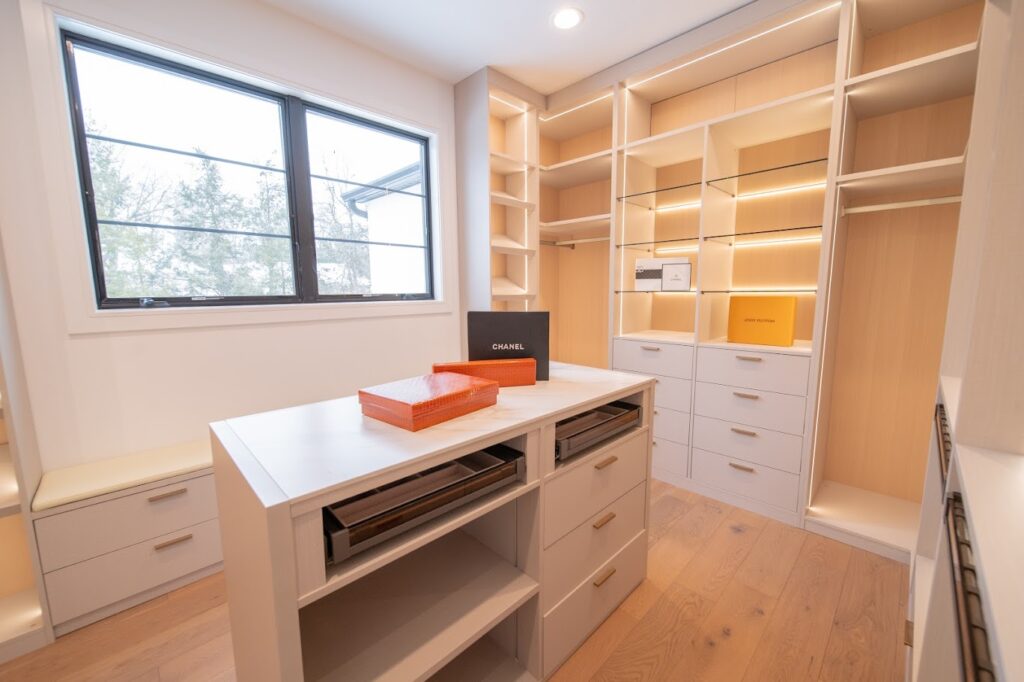
Walk-in closets: Slim Shaker feels modern and tailored; classic Shaker feels timeless.
Bathrooms: Shaker vanities look refined and “furniture-like,” especially with the right hardware and finish.
Home offices & built-ins: Shaker adds structure without visual noise—perfect for media walls, bookcases, and storage runs.
This whole-home consistency is a huge “hidden luxury” because the house feels designed as one system, not a collection of unrelated rooms.
Why choosing the right custom cabinet partner matters (and why it matters more with Shaker)
Because Shaker is simple, mistakes show instantly. Crooked reveals, inconsistent gaps, uneven drawer lines, mismatched sheen, sloppy panel transitions—Shaker doesn’t hide any of it. That’s why the cabinet maker matters as much as the door style.
This is also where you should be brutally practical: the best-looking Shaker kitchens usually come from a process that is disciplined, not casual. The safest way to avoid expensive surprises is to work with a team that confirms specs early and documents the build clearly.
That’s exactly why Americana Studio puts so much emphasis on execution: we manufacture in Pennsylvania, support projects from our office at 117 Route 4 in Paramus, provide white-glove delivery for our regional install footprint across New Jersey and New York, and ship custom cabinetry nationwide across the United States.
But the real reason clients choose us isn’t “a location pin.” It’s what we do around the cabinets:
Fully custom sizing (not semi-custom limits)
Mid to luxury-level finishing and detailing (where Shaker looks premium, not generic)
Storage accessories and functional design that make the kitchen feel better every day
Free design consultation, shop drawings, and measurement verification so decisions are locked before production starts
A build process designed to be fast, reliable, and predictable—because delays are expensive and stressful
If you want Shaker in 2026 done the right way, the win isn’t just choosing Shaker. The win is choosing the right proportions, finishes, and layout—then having a manufacturer who can execute it cleanly.
Are Shaker cabinets still in style in 2026?
Yes. Shaker remains one of the most popular cabinet door styles, and in 2026 the trend is evolving toward slimmer profiles, warmer woods, and more layered finishes.
What are Slim Shaker cabinets?
Slim Shaker keeps the Shaker concept but uses a thinner-looking frame so cabinetry feels lighter and more current.
What cabinet finishes are trending in 2026?
Design coverage highlights a shift toward light wood stains and off-whites, plus more kitchens mixing multiple finishes.
Is honey oak coming back?
Designers are noting a comeback of warmer oak tones, often with matte/satin finishes and updated styling.
How do I make Shaker cabinets look more luxury?
Focus on proportions (often Slim Shaker), clean layout alignment, refined hardware, consistent finish, and smart storage accessories—because Shaker’s simplicity highlights craftsmanship.